
The Revolutionary Lives of Frantz Fanon
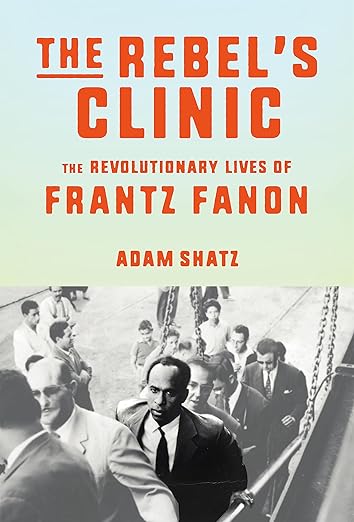
As a psychiatrist shaped by World War II and later a revolutionary thinker against colonialism, Frantz Fanon became an influential intellectual whose work emerged from the tensions of his historical moment. His works, Black Skin, White Masks and The Wretched of the Earth, explore the psychological damage produced by colonialism and racism. This emphasis on psychological injury is central to Adam Shatz’s analysis in his current work. By focusing on Fanon’s thought, Shatz presents the revolutionary as a figure shaped by both the consequences and the moral ambiguity of violence.
Shatz begins by describing Fanon’s work as a psychiatrist in colonial Algeria, where Fanon came to understand colonialism itself as the illness requiring treatment. Drawing on the work of Aimé Césaire, whose poetic language influenced Fanon’s writing, Shatz shows how colonialism deforms both the colonized and the colonizer. Incorporating other revolutionary thinkers, Shatz frames revolution not simply as violence, but as a response to structural injustice, whose moral complexity does not erase the conditions that produced it. Revolutionary violence, while never absolved of ethical ambiguity, is presented as historically intelligible within systems already sustained by colonial violence.
Fanon’s legacy, as Shatz presents it, reckons not only with the repercussions of colonialism but with resistance and rebellion as diagnostic responses to political disorder. In this sense, the “rebel’s clinic” names an ongoing effort to confront and treat the injustices embedded in the modern world.
Reviews and Endorsements for this work including the following:
“Nimble and engrossing … An examplary work … At times as I read The Rebel’s Clinic, I yearned for a little more insight not into Fanon the brilliant doctor or Fanon the rousing revolutionary but Fanon the person … Eloquent.”
— Becca Rothfield, The Wasington Post
“Absorbing … Shatz…is a mostly steady hand in turbulent waters … Part of what gives The Rebel’s Clinicits intellectual heft is Shatz’s willingness to write into such tensions.”
–Jennifer Szalai, The New York Times
“Sober and thorough … One gift of The Rebel’s Clinic is that it amplifies the radical nature of Fanon’s work within the hospital setting … hatz spends enough time complicating the language around violence that we lose sight of the fact that Fanon saw the undivided collective—rather than any particular means to bring it about, violent or otherwise—as the key to resistance, that which he celebrated, codified, and offered back to the world.”
–Sasha Frere-Jones, 4Columns
For more information on this publication, click here:
For more of “On the Lived Theology Reading List,” click here. To engage in the conversation on Facebook and Twitter, @LivedTheology, please use #LivedTheologyReads. To sign up for the Lived Theology newsletter, click here.