
Augustine’s Political Thought
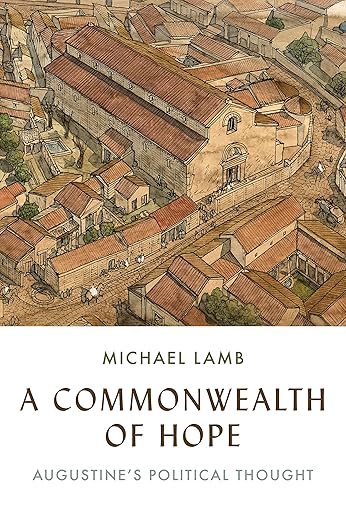
In The City of God, Augustine of Hippo posits that political order cannot fulfill the deepest longings of humanity. Modern society has given politics an inflated hope, only to be disappointed when its promises fall short of these misunderstood expectations. By reframing politics around hope, Michael Lamb uses Augustine’s theology to reframe politics toward a commonwealth. Here, the limitations of politics are understood, but ideas of justice and peace remain paramount.
Lamb begins by introducing the problem in the current political climate, where people have a misunderstood notion of what politics can do, ultimately leading to disappointment. He then turns to Augustine’s theology, where politics is penultimate to justice or peace, thus making it fragile but morally significant. In response to the pitfalls of the political system, Lamb presents hope as a discipline that sustains moral action despite uncertainty rather than a guarantee of success. Here, Lamb introduces the “commonwealth”: a shared community shaped by compromise and a central aim toward justice and morality as the framework for politics. Rooted in democratic life, the “commonwealth” enacts slow positive change without assuming inevitable progress, sustaining hope for ultimate justice and peace beyond politics itself. Overall, Lamb reorients political thought through Augustinian theology toward a more human-centered and justice-oriented framework rooted in shared hope rather than optimism.
Michael Lamb is an associate fellow for the Oxford Character Project and an associate professor at Wake Forest University. earned his B.A. in philosophy and theology from the University of Oxford, and PhD at Princeton University. In addition to the current work, he has co-edited the following publications: “The Arts of Leading,” “Cultivating Virtue in the University,” and “Everyday Ethics: Moral Theology and the Practices of Ordinary Life.”
Reviews and Endorsements of this publication include the following:
“Michael Lamb’s magisterial book gives us an Augustine we so badly need: a great prisoner of hope who resists presumption and despair. Drawing on meticulous scholarship and a creative philosophical analysis of the inimitable African church father, Lamb makes a powerful and compelling case that in our bleak times (much like his) Augustine provides wise encouragement for an active citizenship tempered by humility and mature piety.”
—Cornel West, Union Theological Seminary
“[Lamb] introduces his readers to another Augustine. This Augustine was not a pessimist but a champion of hope. He encouraged his hearers to hope for the well-being of the city. And he possessed an expansive vision of Christians and non-Christians working together to improve their lives on earth.”
—Aaron Alexander Zubia, Wall Street Journal
“A fascinating revisionist view of the political thought of St. Augustine. Contrary to a popular perception of Augustine as an otherworldly thinker who accents ‘darkness and pessimism,’ Lamb sketches a persuasive portrait of a thinker who ‘encourages a realistic hope for a better form of community not only in heaven but on earth.’”
—E. J. Dionne, Washington Post
For more information on this publication, click here:
For more of “On the Lived Theology Reading List,” click here. To engage in the conversation on Facebook and Twitter, @LivedTheology, please use #LivedTheologyReads. To sign up for the Lived Theology newsletter, click here.