
June 4, 2026
By Charles Marsh
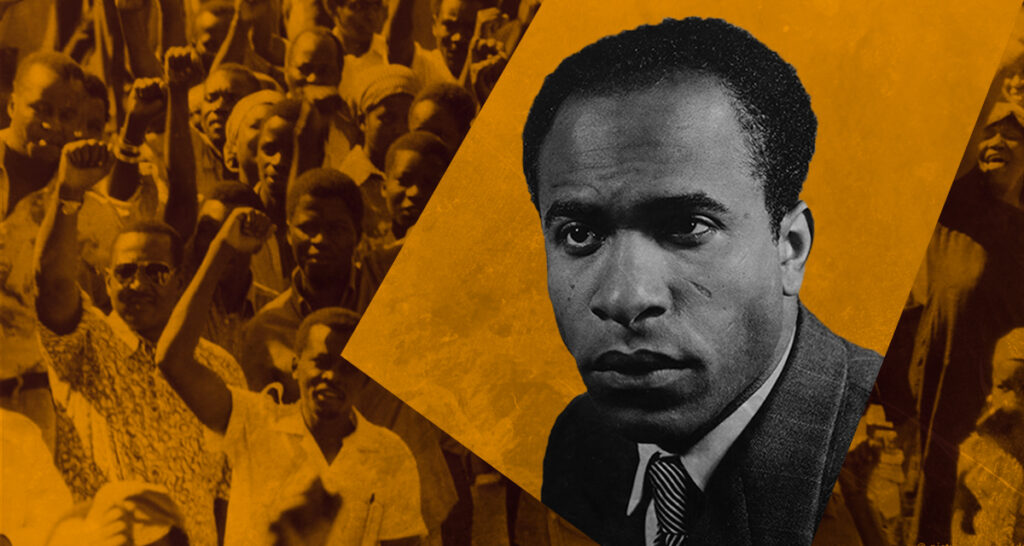
On April 2, 2026, Professor Vincent Lloyd of Villanova University paid a virtual visit to my undergraduate course Religion 3730, “Conversations in Religion”.
In our previous class period, I had discussed Frantz Fanon’s The Wretched of the Earth in conversation with Mary Douglas’s Purity and Danger – which we had read the week before – treating colonial rule itself as a comprehensive purity system.
I traced how Fanon exposes the Manichaean divisions of the colonial world – clean/dirty, civilized/primitive, Christian/non‑Christian – and how missionary Christianity in particular helps sacralize those hierarchies, which Doulgas addressed only briefly in her preface to a later edition.
In his lecture, Professor Lloyd focused on Fanon’s ideas about religion, violence, and the tradition of Black atheism – and pressed the question of how religious languages of reconciliation and more radical, abolitionist gestures of uprooting domination collide in Fanon’s account of decolonization.
I had not been sure it was a good idea to include Fanon in a class called “Conversations in Religion”, in a section that followed Mary Douglas and William James. But Professor Lloyd’s brilliant analysis assured me that it was risk worth taking.
Lloyd shows how Fanon’s account of colonialism across different discourses – through the psychological, political, spatial, moral, and theological –depicts two incommensurable worlds, that of the colonizer and the colonized, for which ordinary frameworks of dialogue, reform, and reconciliation no longer suffice.
Rather than asking what Fanon “says” about religion – he didn’t say a lot, Fanon’s writings on religion are few – Lloyd explores how Fanon’s thought compels religious traditions to discern when their own languages of reconciliation are adequate and when more radical, abolitionist gestures of uprooting systems of domination are required. Along the way, he traces Fanon’s influence on Black studies and social movements, probes the fraught place of Christianity and Islam in colonial and postcolonial struggles, and asks how the tradition of “Black atheism” might be considered a creative response to racialized and colonial religious worlds. Retrieving elements of Fanon’s “dialectical method”, Lloyd surmised, may help scholars of religion and theologians creatively and generatively rethink theories and methods in religious studies.
*
Vincent Lloyd is Professor of Theology and Religious Studies at Villanova University, where he directs the Center for Political Theology and helps lead broader conversations about the intersections of religion, race, and public life. He received his B.A. in Religion from Princeton University and his Ph.D. in Rhetoric from the University of California, Berkeley.
Dr. Lloyd has held fellowships from the American Council of Learned Societies, the Louisville Institute, Durham University, Emory University, and Notre Dame, and in 2024 he was named a Guggenheim Fellow.
His books include Harold Cruse: Critic, Writer, Teacher (Yale University Press, 2026); What Is Political Theology?(with Luke Bretherton and Valentina Napolitano, Columbia University Press, 2025); Black Dignity: The Struggle Against Domination (Yale University Press, 2022); In Defense of Charisma (Columbia University Press, 2018); Religion of the Field Negro: On Black Secularism and Black Theology (Fordham University Press, 2017) From 2012 to 2024 he co‑edited the journal Political Theology, and he now co‑edits the Transforming Political Theologies book series for Routledge.
Vincent was kind enough to edit his lecture for posting here – even in his first busy days as the Leverhulme Visiting Professor, in the Department of Theology and Religious Studies at Kings College, London, where he will teach and write for the academic year 2026–2027.
Spending time with this text, we see just how complex, how rich Fanon’s writing and thinking is, beyond any single slogan.
Fanon was born in 1925 and died in 1961, so all of his work—these two hugely important books, Black Skin, White Masksand The Wretched of the Earth—are both written when he’s quite young, in his twenties and thirties, not even middle-aged. He’s from Martinique, the Caribbean island, and raised in a middle-class family. One of the decisive figures in his thinking is Aimé Césaire.
Césaire is another person who I really enjoy teaching, who has a lot to say about religion, and who is not taught enough in religious studies classes. Césaire was a poet, a theorist, a teacher, and a politician in Martinique. He was part of the movement known as Négritude, which is basically the French equivalent of Black Power or the Black Arts Movement but happening in the 1930s. It’s an artistic and intellectual movement that seeks to reclaim blackness and affirm blackness in a way that’s quite radical, and I think the difference in language sometimes prevents us from hearing that radicality.
The French word from which Négritude comes is like the French equivalent of the N-word, so the movement is taking the most pejorative language that could be attributed to Black people in the French context and saying, That’s the identity we want to affirm. That’s what we want to talk about as not just our identity, but actually the source of all truth, goodness, and beauty. They are not saying, We need to recognize two identities, but that there is an identity that was overlooked, that ought to have primacy, that can allow us to have insights into the world and ourselves that could not otherwise be had, insights for everyone, in some sense.
Césaire is a hugely influential teacher and mentor for Fanon, but Césaire is also of an older generation, and this older generation thinks about national independence and is wary of national independence.
Now, when we think about decolonization, it feels like a pretty straightforward thing, right? These islands, nations, were colonized. France was ruling; they should be free. Modeled on the story of American independence, it seems like you fight for freedom and against colonization, then there’s liberation. This older generation that Césaire was part of actually had a more complex view of what it would mean to achieve freedom for Martinique and for other French colonies. Their vision was not to have total independence, but to transform what the meaning of France is: to have France as just one part of a larger network of French-speaking places which, altogether, would have more votes, so to speak, than just France alone—just the hexagon of France, the core of France in Europe.
If you had all of these different colonies that together, along with the European part of France, made up what we think of as France, there would be a dramatic transformation. So instead of leaving France, the idea was to transform what France means. That is Césaire’s position. Fanon and his younger generation are more radical. They are calling for a hard split from France. Part of what I think we see motivating Fanon’s writing in this text is his desire to explain why this hard split is necessary: why we can’t just reform what we mean by France, expand it, make it more multicultural, make it more pluralistic; why we have to think in different terms.
During World War II, Fanon fights with the Allies—not Vichy France, but the Free French—against the Third Reich. He goes to Europe, experiences Algeria, experiences France, comes back, finishes his studies in Martinique, then goes back to France to continue his studies, where he trains as a psychiatrist. He writes Black Skin, White Masks, published in 1952, then moves to Algeria, at the time a French colony like Martinique but with different religious and racial dynamics.
In Black Skin, White Masks, as the name implies, race and a Black–white binary were the organizing features. Now Fanon finds himself in Algeria, and he notices dynamics that feel very much the same as those he encountered in Martinique, but about colonization instead of a Black–white racial binary. And the way that religion plays out is different. It is a context where Islam and Islamophobia are playing a huge role in the dynamics of colonization, as opposed to the kind of missionary Christianity that was playing a role in Martinique. Another thing we see in this text is Fanon wrestling with what it means to move from a racial framework to a colonial framework. There are moments where he moves into the language of race and then back into the language of colonialism. Are those exactly the same? Are they different? I think that is a tension that remains in this text: how they articulate together.
Fanon is trained in conventional psychiatric practice, but he notices that the dynamics of colonization are affecting individuals’ psyches and mental health. He tries to think through what it would mean to adjust his clinical practice as a psychiatrist in a way that takes account of those social dynamics, and he also tries to think about what it means to theorize politically in a way that takes account of those psychiatric dynamics. He has this clinical practice and this political vision, and the two are feeding off each other. I think that is another underlying dynamic that is really interesting in this text, and one that people sometimes try to play with in political discourse today, but often in a loose way. Fanon feels like he is doing it in a really deep way in this text, from The Wretched of the Earth, which was published in 1961.
Fanon feels constrained by his work in the French colonial health system as he tries to incorporate the social and political framework into his practice. He eventually joins the revolutionary movement in Algeria that is trying to overthrow the French colonial regime—and then dies of cancer, tragically young.
I think it is hard to overestimate the importance of Fanon, and of this text in particular, in moments of social-movement energy in the U.S. and globally, but especially in the U.S. In fact, sometimes in the francophone world Fanon and Césaire and others are overlooked in ways that they are not in the U.S. context.
In the 1960s, people are reading Malcolm X, people are reading James Baldwin, and people are reading Frantz Fanon. Again, in the 2010s—which we can now look back on, even though it feels to me like just yesterday—we can see an era of social-movement effervescence around race, around gender, around Indigeneity, around the environment: all these popular movements calling for justice and growing from grassroots organizing. Frantz Fanon started to circulate widely. People are reading this text on violence and others by him, and he provides a kind of intellectual orientation to grassroots activists, offering language and ways of looking at the world that allow movements like Black Lives Matter to name why respectability or multiculturalism might be problematic frameworks, and why there might need to be a different way of talking about Blackness in that Black Lives Matter context.
Fanon is also really important in Black studies as an academic field, both at that early moment when Black studies is being founded, in the sixties and seventies, and then again in the last fifteen years or so. The recent resurgence is due to a lot of different things, including an alignment between academic work and social-movement work, and currents like Afropessimism, fugitivity, and Black feminism that have made Black studies an export discipline rather than the import discipline it once was—creating theory that goes out to adjacent fields.
In that process, in a moment of intellectual effervescence in Black studies, Fanon is again central—not just taking one idea or one way of understanding him, but wrestling with Fanon: reading, rereading, arguing about this text and a broader set of his texts, and exploring Fanon’s life itself and his clinical practice. David Marriott, a very prominent Black studies scholar now at Emory, has done wonderful work bringing together analysis of Fanon’s clinical practice and his theoretical ideas, and that work is becoming canonical for Black studies today. So Fanon is important in the academy and outside of the academy.
Another thing that was happening in the late 2010s, in terms of how politics was talked about, was a sense that once politics had been dominated by a reform framework, and now we needed to grapple with an abolition framework. That abolition framework might have real political effects today—not just imaginatively in the future, but as a way of organizing, of doing politics. Not just prison abolition or police abolition or immigration and border abolition, although those were currents within these social movements; abolition more generally as a way of thinking about politics, as a way of shifting the frame on whatever issue or mode of engagement is at stake. This text from Fanon offers resources to political actors for thinking about why that shift might be motivated and what it might look like in practice, and that, I think, is really the center of what this text is asking us and opening for us.
The text seems as if it is about violence—that is its name, officially—but it is about so much more. It is about a dynamic underlying colonization, of which violence is just one aspect. That dynamic has political aspects, psychological aspects, social aspects, racial aspects—all wound together. In a sense, that is also the challenge of this essay: there is so much going on. Fanon sees all this messy stuff as a coherent whole with an organizing logic, and he invites us, through looking at details, to see that organizing logic that brings all this messy stuff together.
The intuition I want to invite us to think about, and that I think this piece is pressing, is Fanon’s version of a reform-versus-abolition dynamic. Intuitively, when we encounter a political problem—two groups having a disagreement—there is a strong instinct that we have, as humans, as people in the U.S. now, as people trying to be nice, to have the two groups talk about their interests, name their points of disagreement, clarify them, and then find some way to reconcile, to find common ground that allows them to move forward together. That seems so intuitive, so obvious, that at first it seems as if there is no alternative, as if that is the only way to address a political problem.
It strikes me that what Fanon is trying to say is that there might be problems we encounter in the world for which that mode of address, that mode of looking at them, fails. It just does not work. The text is trying to show us how that could be the case, and it is quite complicated. It is not just a matter of quantity—it is not just that these two groups are very different from each other, or very angry at each other. It is something about the quality of the relationship between the two groups, and about their entanglement: an entanglement that involves asymmetry and can, on Fanon’s view, only be resolved by some kind of dramatic transformation.
That is a really interesting political issue to try to figure out, to investigate, to ask questions about. It also seems like a really interesting question for religion and for religious traditions of all sorts. Religious traditions have both tendencies within them: the reconciliation tendency and the dramatic-transformation tendency. I tend to write and think about the Christian tradition, and certainly at the level of both Christian practice and Christian theology, there are languages of reconciliation that are taken to be so deeply in the tradition that they go unquestioned: that is just how Christianity ought to approach any sort of conflict or disagreement or heterogeneity in the world.
There are also elements of the Christian tradition—ones you do not have to dig very far for, in both practice and theology—that are about overturning the ways of the world, identifying systems of domination, overturning the tables, throwing out the money changers: dramatic gestures that say “no” to the forces of domination, whether they are characterized as demonic or something else. Similar tensions can be found in other religious traditions. Fanon, I think, is putting pressure on religious traditions to think about whether there really are these two different tendencies and how we know when to lean toward one or the other. What are the modes of attending to a site of conflict that help us decide which of these tendencies within a tradition to lean toward?
That is one way that I think about Fanon and religion in this text, which is a bit different from just looking at the places in the text where Fanon says things about religious communities. He does say interesting and surprisingly numerous things about religious communities for a text that is not about religion, and he invokes religious imagery and metaphors and symbols throughout. But both of those—the empirical and the metaphorical—seem rather different from this choice between orientations, one of reconciliation and one of uprooting, that the text also presses.
Let me just draw attention to a couple of other points that struck me. Consider the analysis of a site of conflict that leads Fanon to think this uprooting approach is necessary, and then what that uprooting approach looks like, and then its consequences. Why would this uprooting rather than reconciliation framework be useful or important? Fanon paints a really stark picture of the illusions of order that accompany the dynamics of colonization. It seems as if there is one side in a dynamic of colonization that is orderly and clean and systematic and reasonable, and another side that is the opposite of all those—indeed, the “quintessence of evil,” to use his strong language. If that is the self-image of the colony—that reason, order, system, cleanliness are only on one side—then the possibilities for reconciliation seem limited, and thinking about other forms of transformation is well motivated.
This imagery of order and evil is operating on different levels: on the level of self-image or metaphor; and on the level of the psyche, how people understand themselves, both colonizer and colonized. If you are being told all the time that you are disorderly, unreasonable, dirty, and so on, that has a psychic effect that Fanon is interested in, and that psychic effect may determine the possibilities for reconciliation, the plausibility of reconciliation as a framework.
“Quintessence of evil” is evocative moral language. Fanon is investigating the moral sense of who is good, who is not good, and where a language of value is even appropriate: where it makes sense to apply value, and where, for the colonizer, there is a site that has no value.
There are not only metaphorical and psychological and moral things happening; there is also spatial division. In South Africa there is apartheid, a legal regime of spatial division. In other contexts, including colonial Algeria, there are geographical divisions between where the colonized live and where the colonizers live, marked differently than in apartheid South Africa, but still sharp spatial divisions.
This moving between levels—the moral, the psychological, the spiritual, and the spatial—is characteristic of the kind of analysis Fanon is trying to do here. It is evocative and also a bit hard to deal with, because it is not just a matter of making empirical claims. He is saying all these different levels are tied together. Sometimes this takes a philosophical form, as when he appeals to philosophical language of “being”: what is being, what is a world made of—not just facts, but also ways of reasoning, ways of feeling, ways of desiring, supported by and materialized in institutions and so on, but all tied together and bound up in a world.
If you are painting a picture of two worlds that are incommensurable, then a reconciliation framework may be inadequate. Fanon’s depiction of Christianity as like DDT—as a chemical pest remover that is supposed to help with the cleanliness and health of a population—is, I think, pointing to this way in which he is moving between levels: between the religious and spiritual, the empirical and the metaphorical, the moral and the hygienic, all entangled. When we see Fanon saying Christianity is like pesticide, it is tempting to think that is just a rhetorical flourish. But it seems to me that it is deeply entwined with his philosophical commitments, something he wants us to think with.
Famously, and as the title indicates, violence is one response to this incommensurability of worlds, the world of the colonizer and the colonized. If there cannot be some process of reconciliation—if reason does not work, because reason is monopolized by one side—then something like violence seems necessary, something like an explosion. But if Fanon is always moving between levels—the metaphorical, the psychological, the biological—then what “violence” means is unclear. Violence cannot just be hurting someone else, because he is moving between these levels. Violence stands as a marker for the conflict between two irreconcilable realities that are bumping into each other, not just ways of hurting each other, although that is part of it. Fanon certainly does not deny that people hurting each other is part of violence in the process of decolonization.
In addition to violence, laughter has a role in this text. Mockery has a role—from the perspective of the colonized. These are techniques: laughing at or mocking the language and pretensions of the colonizer are also, like violence, ways of drawing attention to those incommensurable worlds. Rage, too, functions in this way: as a psychic feeling managed in the process of colonization, but sometimes boiling over. Trying to keep rage from boiling over is part of the project of colonization, and yet that management leads to something that looks like hysteria, what Fanon calls “muscular spasms”: moments at which rage manifests in individual or collective life, sometimes in self-destructive ways, associated with a death drive and with internal conflicts between tribes and within Indigenous communities. Violence is thus one of several markers of the tension between two incommensurable communities or worlds in this text.
Let’s turn to the process of decolonization. On Fanon’s understanding, the colonizer—much as in Martin Luther King Jr.’s “Letter from Birmingham Jail”—wants the process of decolonization to be reasonable, measured, with a clear path, a process of dialogue and reform. Fanon urges us to reject that framework because it is dictated from one side that stands in an asymmetrical relation to the other. That strikes me as worth thinking about, and interestingly resonant with religious questions, especially in light of the civil-rights framework in the U.S. that many of us may be familiar with.
Fanon also has interesting things to say about the role of religion and myth as distractions from decolonization. At the same time—he is always a complex thinker—he has things to say about the role of decolonization struggles in shifting attention away from religion and myth. The practicalities of struggle make the myths and mythologies one once lived by seem less important, and that opens up new possibilities for action in the present. It might also open possibilities—Fanon does not say this explicitly, but we might extrapolate—to reconfigure myth and reconfigure religion. I think Fanon hints at this at the very end of his text, where he reflects on the way struggle itself, the struggle against colonization, is generative of something more than just an independent state.
In some ways this is the most fascinating, exciting, compelling, even beautiful part of the text. He is saying that, in this process of two incommensurable things running against each other—the way the colonial world understands itself and those who do not fit the reason of that world—a new humanity, a new humanism emerges: a new way of understanding what it is to be human, for everyone. There was something deeply false about our account of what it means to be human when that account was entangled with colonialism or whiteness or patriarchy or whatever form of domination one wants to name. In the process of struggling against those systems of domination, something new comes into view that we cannot predict, and yet we can hope for it to be good in some way. That strikes me as deeply religiously resonant.
Fanon is also worried that, in the process of struggle, there will be false hopes and illusions, and there will be those who advance their own interests in the name of liberation or overturning colonialism or some other form of domination. What results will not actually be a new humanity; it will be what I would name as idolatry, a version of a new humanity that merely conceals particular interests. At the end of the day, in this process of struggle, Fanon uses language of culture being reborn, of culture emerging; he says the richness of culture is energized in the process of struggle. The name of the essay involves violence, but at the end we arrive at something like beauty: the beauty of culture emerging in the very moment we initially thought would be only violent. That strikes me as a deeply resonant theological idea in any number of theological frameworks across traditions.
So I will stop with that and am very excited to talk about anything.
Question: How does Fanon fit into conversations about theories and methods in the study of religion?
Often, when we are approaching theories and methods in religious studies, we are circling around the question “What is religion?”–how we answer that question, how we properly frame that question. I think the move between levels, the metaphorical, the empirical, the theoretical, the psychological, allowing “religion” to move between all those levels at the same time, offers a resource for theories and methods in religious studies, but in a way that is not centering that question “What is religion?” And that seems really helpful: how can we develop and reflect on theories and methods in a way that does not give that one question a centripetal force?
Question: Fanon says that religion is a distraction. Would Fanon say that Christianity was perverted to continue colonialism, or that Christianity is inherently pro-slavery or pro-colonialism?
That is a great question. I think it is really useful to point out that Fanon is deeply concerned about Christianity as a missionary enterprise that works hand in hand with colonialism. He is also concerned with the way that, after decolonization, Christianity and Islam can be sites where deeper, unresolved tensions in the process of decolonization continue to play out. In both of those cases, what seems to be about God is actually about material interests or some worldly interest. So in that way, it seems as if Fanon is asking a different question: he is neutral on the truth or essence of Christianity and interested in its use—what it is doing in the world at different moments during colonization and after colonization.
I think it is also the case—and this is reading beyond this particular text—that he is invested in a particular kind of dialectical method, which is, without getting too deep into philosophical details, interestingly different from a classical Hegelian or Marxist dialectic. There are subtle distinctions involving the negativity Fanon associates with Blackness and colonization. There is a kind of dialectical process Fanon really cares about: rather than just seeing an object “out there,” he wants to see how that thing unfolds over time, how different interests at play wrestle with each other and are concealed if we just come up with a definition. So if Fanon were to address that question about Christianity, he would see Christianity unfolding in this dialectical process: lots of different interests pushing it in different directions, which are concealed when a theologian or minister or layperson or politician says, “Christianity is about X, that’s the essence of it.”
Question: This is a bit unrelated to your lecture, but I just, in a different class, read Black Natural Law, and we had a great discussion about it. Awesome book—I really liked it. But I was interested: why did you include Du Bois? Because, from my understanding, he was agnostic for much of his life.
Thanks. So this actually gives us an opportunity to think about Professor Marsh’s framing question about Black atheism, which is a complex question. It is tempting to look for an essence of atheism in the same way it is tempting to look for an essence of Christianity, rather than seeing atheism as something unfolding dialectically as well, with different tensions—the refusal of God or belief in God, and the development of institutions that turn away from God in some way—fueled by competing interests. That is one thing to say about the category of atheism. It is all the more complicated when that unfolding process is embedded in a broader process of racialization and what Fanon here calls colonization.
For the colonized, what does it mean to be an atheist? Does it mean simply to refuse colonial Christianity and Islam? Or does it mean to be involved in a process of wrestling with those traditions? Is atheism itself, as the flip side of established religion, a colonial category that is then appropriated or resisted by the colonized? There is a whole set of questions that could be pursued. There has been quite interesting historical research over the last decade or so around African American atheism and freethought, and Du Bois—this towering nineteenth–twentieth-century Black intellectual—is often associated with some kind of Black atheism or freethought, even though he writes books that are deeply spiritual and use the language, imagery, and metaphors of Christianity. He is reluctant to say things like “I believe in God” or “I will lead a prayer.”
Once we have a more complex sense of critically wrestling with Christianity or religiosity as part of what it means to be an atheist in a colonized or racialized context, it is more comfortable to see Du Bois as part of that tradition. All that being said, in the book you are referring to, Black Natural Law—which is an account of how those famous phrases of Martin Luther King Jr. in “Letter from Birmingham Jail” about God’s law being violated by segregation are not just rhetorical flourishes but part of a long tradition of African Americans drawing on traditions that appeal to a higher law or God’s law or a law of nature, from Frederick Douglass to Anna Julia Cooper to Du Bois and into the present—the official line is that natural law is religiously neutral. There is a process of discerning a higher law based on reflection on human nature that is shared by this tradition and that has an ideology-critical function and a social-movement organizing function. Sometimes that is accompanied by language of God; sometimes it is not.
The unfortunate thing about that book is that the publisher put a giant cross on the cover, which makes people think the book’s claim to religious neutrality is not very sincere. But in the logic of the book itself, you are supposed to be able to read it ignoring the cross on the cover and see it explicating a process of discerning a higher law, rather than necessarily the law of the God of Jesus Christ.
Question: I was wondering if you could speak on the theory that atheism itself has emerged from a place of privilege—this idea that atheism comes from being able not to hold onto the cultural traditions and hope that come with religious experience, and that is why we see it more in less marginalized communities—and if you could speak on that dichotomy within Black atheism.
That is a good question. There is a popular-level conversation about atheism and a scholarly conversation, and sometimes they speak past each other. There are also philosophical discussions about atheism, there is atheism as an organized movement (people who join atheist groups), people who check the “atheist” box on a form, and then what people say to themselves in their hearts at night. There is a lot of messiness to sort through in discussions of atheism, all the more so under the shadow of race.
There certainly is a narrative—and narratives exist because they have some truth in them—that atheism comes from a position of privilege. I like the way you put it: to imagine yourself as standing alone, apart from tradition, community, and hope in an afterlife, can only happen when your material needs are met and you are not worried about your next meal or various forms of violence. There is something plausible about that story. What it means concretely is less clear: is this about what people say in their hearts, is it about joining groups, or is it about checking a box?
It is also the case that there are Black atheist groups: forms of community that grow out of a commitment to questioning or rejecting religious traditions. In some ways, the kind of community that emerges when outsiders or people who feel alienated find each other and gather can be even stronger than the default religious community one grew up in. If you have that willfulness to question and stand apart, and then you find others who share it, together you can engage in that enterprise and build community. There can be something really powerful and meaning-making about that, and not entirely “unreligious,” even as it is ostensibly about atheism.
In contexts of colonization and racialization, as this Fanon essay points us to, there are all sorts of creative and unexpected responses that are sometimes dismissed as hysterical or as “muscular spasms,” in his language. One might think of the Marcus Garvey movement or various new religious movements in African and African diaspora worlds that might seem odd: wearing uniforms, getting together on Sunday mornings but not talking about church, being somewhat aligned with religious communities but also standing apart and doing something creative and new—something that looks like mimicry, like laughing at or playing with dominant forms of religiosity. That creativity is worth attending to. Black atheism, if we are going to use that category, might well be classified as a kind of mimicry, mockery, creative performance, and community-building, even as it might seem to require a kind of privilege to participate in.
Charles Marsh: May I ask one final question? I think this returns us to the theme of reconciliation. Fanon saw in North African Islam resources for anti-colonial collaboration and mobilization. I am particularly moved by—have you seen this letter to Ali Shariati? It is in Frantz Fanon: Alienation and Freedom. I do not know much about him; he is an Iranian patriot, militant, student of Sartre and Merleau-Ponty. I have not read other correspondence between them, but in this letter, written to Shariati, Fanon has a very moving final paragraph. Shariati proposes something like digging into the myths and images of Iranian Islam to marshal resources for revolution, and Fanon says, at the end of his reply:
“However, your interpretation of the rebirth of religious spirit and your efforts to mobilize this great power for the aim of emancipating a large part of humanity threatened by alienation and depersonalization is the path you have taken. The manner of Senghor, Kenyatta, et cetera, all of whom undertake to revive African nationalism, or else of Henri Alleg’s revival of classicism. As for myself, although my path diverges from and is even opposed to yours, I am persuaded that both paths will ultimately join up towards that destination where humanity lives well.”
I find that a very moving, almost benedictory, moment in his thought and wondered if you had your own benediction for us.
[laughs] I do not think I have anything that can compare to that, but thank you for drawing our attention to it. I do think there is something really important about approaching a figure like Fanon, who can be so easily reduced to simplistic slogans or characterizations, and grappling with the complexity and richness of his ideas—even when, on the surface, they seem repulsive or irreconcilable with other commitments we might have. I think the dialectical method that I read at the very heart of Fanon’s thought—beyond anything specifically about decolonization or violence—is a method of attending, grappling, thinking together, and creating something beautiful and new. The letter you pointed to really draws this out.
Charles Marsh: This is not the response of a doctrinaire mind to conversation or to the religious repertoire of emancipation. It is an affirmation of co-humanity and of the possibilities of marshaling resources from religious traditions toward a shared goal. It reminds me, in a very different sense, of some of Thomas Merton’s ideas in that amazing book Faith and Violence, which has an essay on Black Power that draws heavily on Fanon and on Fanon’s influence on Stokely Carmichael. Next time this comes up, we should just bring you to town and go out for dinner. This is such a gift to us, Vincent, and we are very grateful for this time together.
Thank you so much. I am looking forward to next time, and I wish you all well at the end of the semester. Take care.