On the Lived Theology Reading List: Nineteenth-Century American Women Write Religion

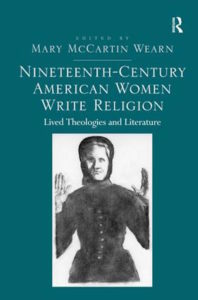
Nineteenth-Century American Women Write Religion Lived Theologies and Literature By Mary McCartin WearnNineteenth-Century American Women Write Religion: Lived Theologies and Literature, by Mary McCartin Wearn book coverLived Theologies and Literature

Religion was largely ingrained into the identity and everyday existence of the nineteenth-century American woman, shaping the literature female authors produced. Nineteenth-Century American Women Write Religion examines this vast collection of fiction, political writings, poetry, and memoirs to explore the diversity of religious discourse of the time as told by authors, activists, and faith believers, including Elizabeth Stuart Phelps, Angelina and Sarah Grimké, Louisa May Alcott, Rebecca Harding Davis, Harriet E. Wilson, Sarah Piatt, Julia Ward Howe, Julia A. J. Foote, Lucy Mack Smith, Rebecca Cox Jackson, and Fanny Newell. The collaborative product of ten scholars, this work focuses specifically on the lived theologies of these women, illuminating the ways they used the language of religious sentiment amidst the largely repressive context they found themselves in.

Mary McCartin Wearn opens with an introduction of the text, writing:

“Women’s literature of the nineteenth century provides an excellent artifact through which to illustrate the complicated and varied experience of religion in women’s lives. While feminine piety was a powerful force in the home, church, and community, women’s spiritual leadership was largely unofficial…

In a world where women were declared religious by nature but denied any official stature within the Church, the written word became an excellent means of establishing cultural authority and expressing faith in the public sphere.”

For more information on the book, click here.

Fellow travelers are scholars, activists, and practitioners that embody the ideals and commitments of the Project on Lived Theology. We admire their work and are grateful to be walking alongside them in the development and dissemination of Lived Theology.
For more of “On the Lived Theology Reading List,” click here. To engage in the conversation on Facebook and Twitter, @LivedTheology, please use #LivedTheologyReads. For more recommended resources from our fellow travelers, click here, #PLTfellowtravelers. To sign up for the Lived Theology monthly newsletter, click here.

Director Charles Marsh Featured in UVA Today

cm-uva-todayOn the Mission of the Project on Lived Theology
Established in the summer of 2000, the Project on Lived Theology studies the implications for social justice and human flourishing that lie at the intersection of faith and lived experience. It is our conviction that the patterns and practices of religious communities offer rich and generative material for theological inquiry and that, properly interpreted, the lived experiences of faith are communicative not only of a religious community’s collective self-understanding but of modes of divine presence as well. Bridging the gap between academia and the everyday, the Project further endeavors to demonstrate the importance of theological ideas in the public conversation about civic responsibility and social progress.

Founder and director Charles Marsh recently discussed these beginnings, influences, and goals of the Project in an interview with UVA Today, stating:

“My father took a position at the First Baptist Church of Laurel, Mississippi in 1967. The six years we lived there portended the last days of segregation in the South, and I was a participant in the first integrated school system in the state. I was trying to make sense of all that was happening, which became quite overwhelming at times.

Later in my graduate work, I began to think seriously and theologically about the religious conflicts and paradoxes of that time. Why were some of the same white, Southern evangelical Protestants who nurtured me in the faith and gave me a love of the Bible and of church life, nonetheless completely indifferent to, if not contentious towards, the sufferings of African-Americans under Jim Crow?

Every side of the movement, from Klansman to liberal leaders, in some way invoked God’s name and divine legitimacy. I began asking how people thought about God and why their ideas of God and church compelled them to react as they did to integration. For me, it opened an interesting, fresh way of thinking about religious questions. It also marked the beginning of the Project on Lived Theology, which is essentially making sense of how theological convictions are lived out in social existence.”

To read Marsh’s full interview with UVA Today, click here. Find more information on the Project here.

Charles Marsh is the Commonwealth Professor of Religious Studies at the University of Virginia and the director of the Project on Lived Theology. His research interests include modern Christian thought, religion and civil rights, Dietrich Bonhoeffer, and lived theology. His publications include Strange Glory: A Life of Dietrich Bonhoeffer (2014) and God’s Long Summer: Stories of Faith and Civil Rights (1997), which won the 1998 Grawemeyer Award in Religion.

Engage in the Lived Theology conversation on Facebook and Twitter via @LivedTheology. To sign up for the Lived Theology monthly newsletter, click here.

On the Lived Theology Reading List: Union Made

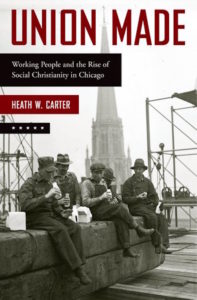
Union Made: Working People and the Rise of Social Christianity in Chicago, by Heath W. CarterWorking People and the Rise of Social Christianity in Chicago
While the late 1800s brought a period of tremendous economic growth to the United States, this Gilded Age also revealed the extreme poverty and inequality suffered by the working class. In Union Made, author Heath W. Carter credits the beginnings of a new discipline– American Social Christianity– to these common laborers rather than the more often credited middle-class spiritual leaders of the day.

Workers believed God stood behind organized labor; institutional church leaders had strayed from the true gospel in their suspicions and reservations. With more and more working believers turning away from a false church, Carter writes that American Christianity was saved only when pastors embraced the plight of the common man in the spirit of the Social Gospel. Penned in the midst of a “New Gilded Age” developing today, Union Made offers a new way forward through lessons from the past.

Reviews and endorsements of the publication include:

“In contemporary America, where the gulf between the rich and poor threatens to yawn that wide again, Christianity and conservative politics have become so intertwined that many American believers are convinced that their faith mandates small government….Carter, however, shows us a different route.” —Church History

“No mere opiate or tool of oppression, working-class faith emerges from the pages of this extraordinary book as the generative force that made the nineteenth-century social gospel viable. Social Christianity made resistance against industrial capitalism and its barons a possible and necessary thing. Combining the finest qualities of classic social, urban, and labor histories with the curiosities of our scholarly (and political) moment, Union Made is a sharp, much-needed reminder that American Christianity has not always been free-market in persuasion or comfortable on the corporate side. Beautifully crafted, it is also a stirring must-read.” –Darren Dochuk, author of From Bible Belt to Sunbelt: Plain-Folk Religion, Grassroots Politics, and the Rise of EvangelicalConservatism

“In recovering these working-class voices, Carter makes a significant scholarly contribution to the field of American religious history while also deepening our understanding of the labor movement during the Gilded Age and Progressive Era. More than just recasting the origins of Social Christianity, he reminds us of the profound moral debates that surrounded the rise of industrial capitalism and reveals how workers campaigned for justice as forcefully and ardently within the religious sphere as they did in the political and economic arenas.” –Thomas Rzeznik, The Journal of the Gilded Age and Progressive Era

Find more information on the book here.

Fellow travelers are scholars, activists, and practitioners that embody the ideals and commitments of the Project on Lived Theology. We admire their work and are grateful to be walking alongside them in the development and dissemination of Lived Theology.

For more of “On the Lived Theology Reading List,” click here. To engage in the conversation on Facebook and Twitter, @LivedTheology, please use #LivedTheologyReads. For more recommended resources from our fellow travelers, click here, #PLTfellowtravelers. To sign up for the Lived Theology monthly newsletter, click here.

John Kiess Pursues New Book Project on Contemporary Warfare

Va Sem 2 2011 2013 2005 SILT John KiessExamining the Implications of the Conflict Economy
Burdens of war extend far past the battlefield as civilian injury and death continue to constitute an increasing proportion of total casualties. In his current book project, John Kiess focuses on civilian vulnerability in contemporary war through case studies on the Democratic Republic of the Congo and beyond. Unpacking the idea of the conflict economy and its impact on civilian livelihood, Kiess analyzes various strategies implemented to address it and the unintended and harmful consequences many plans produced.

Kiess also addresses war reparations, specifically the use of restorative justice versus judicial punishment in the International Criminal Court (ICC). While international law leans towards only either end of the spectrum, he assesses the middle ground of restorative punishment and its future prospects in the ICC. The court’s implementation of the Rome Statute principles of victim participation, protection, and reparations is then evaluated to further increase their restorative impact.

Kiess concludes with lessons learned from past warfare to improve overall responses to addressing conflict development and civilian endangerment and offers recommendations for international courts to advocate for restorative justice.

For more from Kiess, read his most recently published analysis in his chapter, “Descending into the Ordinary: Lived Theology, War, and the Moral Agency of Civilians,” of PLT’s newest publication: Lived Theology: New Perspectives on Method, Style, and Pedagogy.

John Kiess is an assistant professor of theology at Loyola University Maryland. His doctoral dissertation explored the ethics of war through the lens of the Democratic Republic of Congo, where he conducted fieldwork in 2008-2009. In addition to his work on conflict and peacemaking, he is also interested in political theology, political theory, and philosophy, and is the author of Hannah Arendt and Theology (2015) as well as several articles and book chapters.

For more of featured writings of our PLT Contributors, click here. To engage in the conversation on Facebook and Twitter,@LivedTheology, please use #LivedTheologyWrites. To sign up for the Lived Theology monthly newsletter, click here.

On the Lived Theology Reading List: Madness

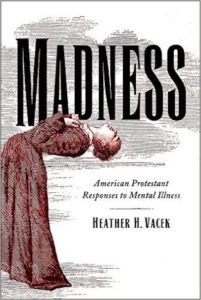
Madness: American Protestant Responses to Mental Illness, Heather H. Vacek, Fellow TravelersAmerican Protestant Responses to Mental Illness

Mental illness has always comprised a fundamental component of health, although the overwhelming majority of historical evidence shows little acceptance of and care for affected individuals. In Madness, Heather Vacek follows this trend in the American Protestant church’s response to mental illness through the last three centuries. Rooted in the notion that sickness was a consequence of sin, faith believers avoided association with patients and left them to the care of secular medical professionals.

However, five notable figures stood apart from this idea to reclaim the Christian response to mental illness: colonial clergyman Cotton Mather, Revolutionary-era physician Benjamin Rush, nineteenth-century activist Dorothea Dix, pastor and patient Anton Boisen, and psychiatrist Karl Menninger. Vacek considers these leaders amid the landscape of mass indifference to offer a way forward in the Christian care of patients and overall understanding of mental illness today.

In an excerpt from the book, Vacek writes:

“Human suffering concerned American Christians, but not all shapes of distress earned the same response. Beginning in the colonial era, Protestants professed to care for the well-being of bodies, minds, and souls, but those living with mental illnesses often received minimal attention…

The exploration of Protestants and mental illness demonstrates what appeared – and failed to appear – on congregational agendas. It also offers insight into how Christians engaged suffering, particularly seemingly intractable suffering. Within congregations, sufferers and their families struggled to voice their concerns about mental illness. Many simply remained silent and failed to receive the ministrations of the church. This volume explores why their journeys proved so difficult.”

To read more on this publication, click here.

Fellow travelers are scholars, activists, and practitioners that embody the ideals and commitments of the Project on Lived Theology. We admire their work and are grateful to be walking alongside them in the development and dissemination of Lived Theology.

For more of “On the Lived Theology Reading List,” click here. To engage in the conversation on Facebook and Twitter, @LivedTheology, please use #LivedTheologyReads. For more recommended resources from our fellow travelers, click here, #PLTfellowtravelers. To sign up for the Lived Theology monthly newsletter, click here.

Save the Date: Firmin DeBrabander to Lecture in March 2017

gun, Firmin DeBrabander eventA Christian Critique of the Gun Movement
The core argument of Second Amendment advocates is that the proliferation of firearms is essential to maintaining freedom and safeguarding our rights in America, but is this argument valid? With his 2015 publication Do Guns Make Us Free?, Firmin DeBrabander tackles this question with an essential examination of the political and philosophical arguments of the contemporary gun rights movement in the United States. By exposing the contradictions and misinterpretations inherent in the case presented by gun rights supporters, he demonstrates that an armed society is not a free society but one that actively hinders democratic participation.

Drawing on this work, DeBrabander will deliver two guest presentations at the University of Virginia on Tuesday, March 14, 2017 to discuss the “Christian” critique of the gun movement based on the Catholic social teachings.

Following a class discussion and book signing at 2:00 pm, he will lead a public seminar with interested students and other area practitioners at 5:00 pm. Both events are free, and the public is invited to attend. More details will be announced closer to the event.

Find more information on DeBrabander’s publication here.

Firmin DeBrabander is professor of philosophy at the Maryland Institute College of Art in Baltimore. He completed his graduate studies at the Katholieke Universities Leuven in Belgium, and at Emory University in Atlanta. His publications include Spinoza and the Stoics (Continuum Press, 2007) and Do Guns Make us Free? (Yale University Press, 2015). He has written articles on social and political commentary (notably on the gun debate) in a variety of national publications, including The Baltimore Sun, The New York Times, the Washington Post, the Atlantic, the New Republic and Salon.

For more event details and up-to-date event listings please click here to visit the PLT Events page. We also post updates online using #PLTevents. To get these and other news updates, please like us on Facebook and follow us on Twitter @LivedTheology. To sign up for the Lived Theology monthly newsletter, click here.

On the Lived Theology Reading List: American Prophets

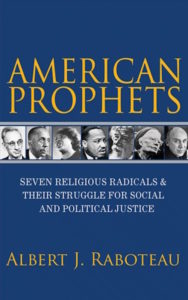
American Prophets: Seven Religious Radicals and Their Struggle for Social and Political Justice, Albert J. RaboteauSeven Religious Radicals and Their Struggle for Social and Political Justice
In his latest release, acclaimed religious scholar Albert Raboteau explores the theology and legacy of seven major prophetic figures in twentieth-century America: Joshua Heschel, A. J. Muste, Dorothy Day, Howard Thurman, Thomas Merton, Martin Luther King, Jr., and Fannie Lou Hamer. Called to social activism to address the suffering of others, these leaders professed their faith through acts of writing, speaking, and demonstrating. Raboteau examines the influences that inspired them, the theology that grounded them, and the ways in which they convinced generations of Americans to join their cause. American Prophets illustrates the profound meaning lying at the intersection of thought and action, an inspiring testimony to lived theology at its best.

Reviews and endorsements of the publication include:

“Compelling and provocative. . . . A momentous scholarly achievement as well as a moving testimony to the human spirit, American Prophets represents a major contribution to the history of religion in American politics. This book is essential reading for anyone who is concerned about social justice, or who wants to know what prophetic thought and action can mean in today’s world.” -Rabbi Dov Peretz Elkins, JewishMediaReview

“Albert Raboteau is the legendary godfather of Afro-American religious studies. He also is one of the exemplary spiritual radicals of our time. This wise and courageous book solidifies both well-deserved reputations.”-Cornel West

“Albert Raboteau’s magnificent American Prophets is a book that will make our hearts soar. Courageous, wise, and deeply compassionate, Raboteau’s prophets are political activists–Jews and Christians, blacks and whites, men and women–imbued with a deep faith in God and humanity. An inspiring journey into the inner lives of extraordinary human beings.”-Susannah Heschel, author of The Aryan Jesus: Christian Theologians and the Bible in Nazi Germany

Find more information on the book here.

Albert J. Raboteau arrived at Princeton in 1982 as a specialist in American religious history. His research and teaching have focused on American Catholic history, African-American religious movements, and the place of beauty in the history of Eastern and Western Christian Spirituality. His other publications Slave Religion: The ‘Invisible Institution’ in the Antebellum South (2004) and A Fire in the Bones: Reflections on African-American Religious History (1996). He was the first recipient of the J.W.C. Pennington Award from the University of Heidelberg and delivered the Stone Lectures at Princeton Theological Seminary in 2012. He retired in June 2013. 

Albert J. Raboteau passed away on Sept. 18, 2021. Read his New York Times obituary (Oct. 13, 2021) to learn more about this amazing scholar.

For more of “On the Lived Theology Reading List,” click here. To engage in the conversation on Facebook and Twitter, @LivedTheology, please use #LivedTheologyReads. To sign up for the Lived Theology monthly newsletter, click here.

PLT Definitive Collaboration with Oxford University Press

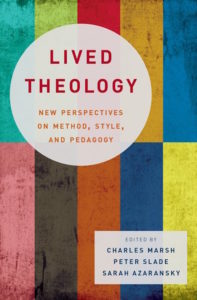
Lived Theology: New Perspectives on Method, Style, and Pedagogy; Charles Marsh; Sarah Azaransky; Peter SladeNew Perspectives on Method, Style, and Pedagogy
The Project on Lived Theology is delighted to announce the release of our new book, available now at Oxford University Press, Amazon, and other retailers. Use promo code AAFLYG6 for 30% off at the OUP site.

Join the conversation about the book on Facebook, Twitter, and Instagram, using #LivedTheology.

And if you’re in the San Antonio area during the American Academy of Religion annual meeting, please join us for a celebratory reception, Saturday, November 19, from 7 to 9 p.m. in the Pecos Room at the Hyatt Regency San Antonio Riverwalk.

Lived Theology contains the work of an emerging generation of theologians and scholars who pursue research, teaching, and writing as a form of public responsibility motivated by the conviction that theological ideas aspire in their inner logic toward social expression. Edited by Charles Marsh, Peter Slade, and Sarah Azaransky, this volume offers a series of illustrations and styles that distinguish Lived Theology in the broader conversation with other major approaches to the religious interpretation of embodied life.

The book begins with a modest query: How might theological writing, research, and teaching be expanded to engage lived experience with the same care and precision given by scholars to books and articles? Behind this question lies the claim that theological engagements and interpretations of lived experience offer rich and often surprising insights into God’s presence and activity in the world. Lived Theology offers a fresh and exciting model for scholars, teachers, practitioners and students seeking to reconnect the lived experience of faith communities with academic study and reflection.

The contributors with a chapter in the publication, three of whom recently received Grawemeyer Awards, include Sarah Azaransky, Jacqueline Bussie, David Dark, Susan Glisson, John de Gruchy, Susan R. Holman, Lori Brandt Hale, Willis Jenkins, Willie James Jennings, John Kiess, Jennifer M. McBride, Mary McClintock Fulkerson, Charles Marsh, Peter Slade, and Ted Smith.

For more information on the book, click here. Connect to the Facebook event for the book reception here.

For more of featured writings of our PLT Contributors, click here. To engage in the conversation on Facebook and Twitter, @LivedTheology, please use #LivedTheologyWrites. To sign up for the Lived Theology monthly newsletter, click here.

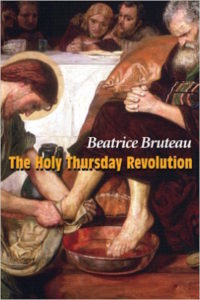
On the Lived Theology Reading List: The Holy Thursday Revolution

The Holy Thursday Revolution, Beatrice BruteauChanging the Narrative from Foe to Friend
Is there any hope for a future of better relations and peaceful coexisting between and among communities? Author Beatrice Bruteau says yes, basing her argument on two practices of Holy Thursday: the Footwashing and the Supper, or Holy Communion. She illustrates “how this new paradigm–a movement from Lord to friend–can dramatically alter our personal and social relations, our economic and political practices.” Creating new hopes out of a 2000-year-old tradition, The Holy Thursday Revolution is Bruteau’s longing for the transition from a world of distrust and dominance to one of peace and understanding.

In an excerpt of the 2005 publication, Bruteau writes:

“‘Love your neighbor as yourself.’ This is such a well-known saying among us that we may not realize the profound dissonance involved, but we know that we are not able to live up to this ideal. We have excused ourselves by saying that it is an ideal, after all, and very difficult to attain, and we can only hope to approximate it sometimes and to a certain extent.

But this, according to my thesis, is not the trouble. The difficulty is that this exhortation flies in the face of everything else that our culture encourages and that our worldview sees. If we cannot love our neighbor as ourself, it is because we do not perceive our neighbor as ourself. We perceive the neighbor as precisely not ourself, but as a potential threat (or potential aid) to ourself… It is not a matter of the exhortation being an ideal that is difficult to attain; it is a contradiction of our culture that is strictly impossible to realize, so long as we see the world the way we do.”

Find more information on this book here.

Fellow travelers are scholars, activists, and practitioners that embody the ideals and commitments of the Project on Lived Theology. We admire their work and are grateful to be walking alongside them in the development and dissemination of Lived Theology.

For more of “On the Lived Theology Reading List,” click here. To engage in the conversation on Facebook and Twitter, @LivedTheology, please use #LivedTheologyReads. For more recommended resources from our fellow travelers, click here, #PLTfellowtravelers. To sign up for the Lived Theology monthly newsletter, click here.

Presentations Mark Close of 2016 Internships in Lived Theology

PLT Interns Reflect on Summers of Service

On September 15, the interns shared memorable stories and theological reflections from their summer work with the community, wrapping up this year’s summer internships in lived theology. The cohort included Tessa Crews (Col ’16), Brit Dunnavant (Col ’17), and Elizabeth Surratt (Col ’17).

“One verse that really spoke to me is from the Bhagavad-Gita because I like to read it daily. It was one that I would reflect on while I was out doing my work because it reminded me of how to see God in nature. It goes, ‘I am the original fragrance of the Earth.’ So I would be pulling the weeds and I would smell the scent of moist soil… it’s so rich and vibrant that you think, God smells like this. That’s amazing. That’s really incredible.”

A 2016 graduate of U.Va.’s College of Arts and Sciences, Tessa Crews completed a summer internship at the Green Comfort School of Herbal Medicine in Washington, Virginia. Crews learned about integrating herbs, foods and supplements necessary to achieve optimal health and wellbeing and worked to educate the community about this mission. She was mentored by Vanessa Ochs and Teresa Boardwine.


“A lot of times I went into my theological work, going into the Haven looking for big moments, for moments that I thought would really radically reorient my thinking, but it had to be something good… As I thought about it more, it became clear that it wasn’t these big moments that would completely reorient everything, but it was a million small moments that would come together to radically transform.”

Britton Dunnavant, a fourth year student majoring in religious studies, spent his summer working at The Haven in Charlottesville. An organization working to end homelessness, The Haven runs a day shelter and administers housing-focused programming. With the help of his two mentors, Heather A. Warren and Stephen Hitchcock, Dunnavant reflected theologically on his duties in the kitchen and in working with other staff members and guests.


“It was during this period that I started realizing that it’s not about me… I know very little of Barth, but the part I did read was about divine command and how we always try to look at what’s ethical, what do we do in the moment to do everything right. There’s one decision we have to make, and that’s the decision to surrender our lives and our actions to God. And from that place of complete surrender to his command, that’s where we’re acting in the world in a way that is pleasing, that is honorable.”

Elizabeth Surratt is a fourth year student majoring in political and social thought with a minor in religious studies. Guided by mentors Nichole M. Flores and Mo Leverett, Surratt cultivated relationships with inner city middle school girls through an internship with Rebirth Community Ministries in Jacksonville, Florida. Rebirth’s mission involves mentoring next-generation urban ministry entrepreneurs in the most at-risk American communities.

To read the intern blog compiled of each student’s reflections over the summer, click here.

The Summer Internship in Lived Theology is an immersion program designed to complement the numerous existing urban and rural service immersion programs flourishing nationally and globally by offering a unique opportunity to think and write theologically about service.

For updates about the PLT Summer Internship, click here. We also post updates online using #PLTinterns. To get these updates please like us on Facebook and follow us on Twitter at @LivedTheology. To sign up for the Lived Theology monthly newsletter, click here.