Adaptogens taste like summer

Roots

And the earth brought forth grass and herb yielding seed… and God saw it was good.
-Genesis 1:12

The summer solstice is here and Teresa and I are preparing for the afternoon festivities. Today we will be having a medicine making open house during which herbal school alumni and family friends are invited to harvest from the garden, process their own plants, and leave with a batch of homemade medicine. But if we weren’t in the celebratory spirit before, we both are now… I’m making bonbons!

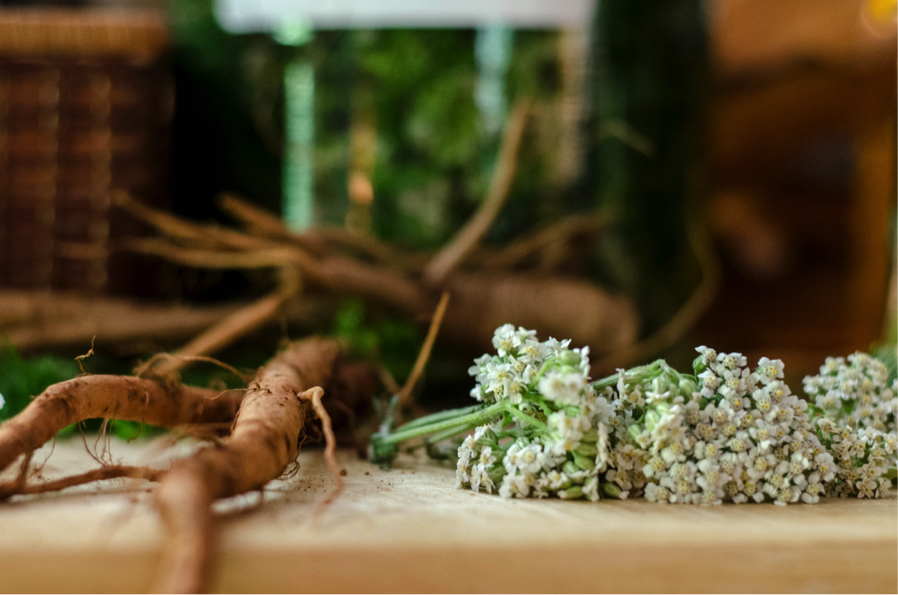
The yurt comes to life with the very utterance of these two syllables. A well-known favorite among her students, the restorative treats are a recipe for delectable health and wellbeing. Basically, a combination of nut butters, raw honey, coconut oil, and dried fruits create a variety of euphoric taste sensations. Then we add a medicinal dose of adrenal adaptogen herbs and the result is a sweet tasting powerhouse to help the body combat symptoms of fatigue and exhaustion.

After scouring the Herbal School library, I found several books that explain why these herbs have such a soothing effect on the body. In Adaptogens: Herbs for Strength, Stamina, and Stress Relief, I read the following physiological explanation:

“Adaptogenic herbs support the entire neuroendocrine system, in particular the adrenal function, thus counteracting the adverse effects of stress. Adaptogens also help the body with its natural adaptive responses to stress. They do this by exerting a biochemical influence on the hypothalamus and its two main systems to signal stress—the HPA [hypothalamic-pituitary-adrenal] axis and the SAS [sympathoadrenal]” (Winston, 72).

Adrenal adaptogens are all about bringing back a sense of homeostasis to the body. For the solstice recipe, our adaptogens of choice are ashwagandha and maca powder. Although I was previously more familiar with maca, I am curious to learn that ashwagandha in particular a calming, rather than stimulating, herb and is known in ayurvedic medicine as prolonging life and increasing stamina (Winston, 141). When mixed with sunflower seed butter and honey these herbs make medicine an indulgent experience.
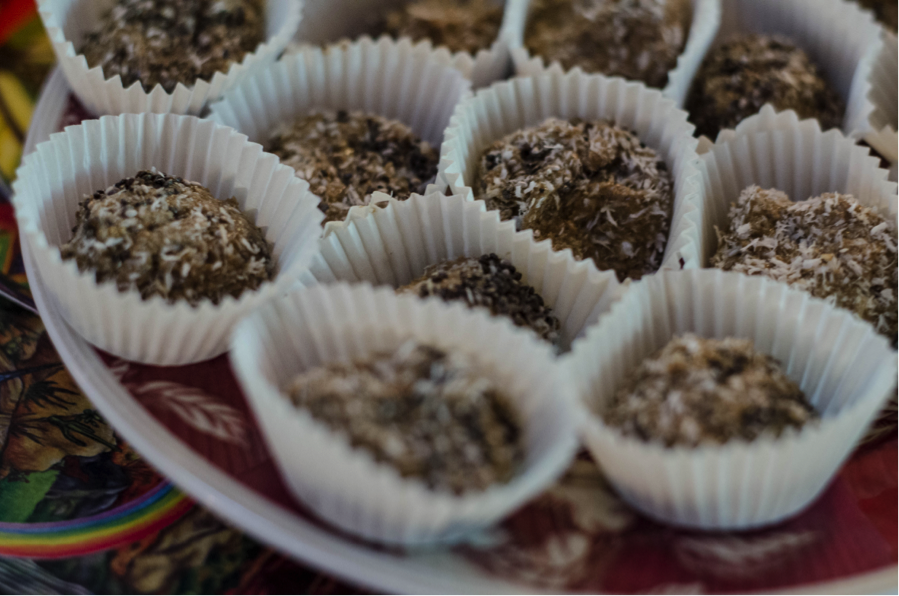
Bonbons

Sunflower Solstice Bonbon Recipe:

Adrenal Support in Celebration of Summer Health and Vitality

Ingredients:

½ cup sunflower nut butter
¼ cup raw, local honey
2 T. ashwaganda powder
2 T. maca powder
½ cup coconut flakes
½ cup chia seeds

Directions:

Mix the nut butter and honey in a bowl until the contents achieve a fluid and homogenous consistency. Then add the maca and ashwaganda powder until the mixture becomes more firm and dry: comparable to that of cookie dough.

Prepare the topping by placing the coconut flakes and chia seeds in their own separate bowls. Using a spoon, melon scooper, or gloved hands, scoop a quarter sized ball of bonbon mixture and place it into your topping of choice: coconut flakes, chia seeds or both! (Note: the toppings can be substituted for other dried nut powders, cocoa powders, or dried fruits).

Roll the bonbon in the topping until it is round, firm, and evenly coated. Place the individual treat in a mini baking wrapper. Offer with love and devotion and savor the blessing of tasty medicinal treats.

Yields approximately 20

Warning: yield is subject to fluctuate. You may have to add more powder to the mixture if the desired consistency is not achieved. Firmness is correlated with the oiliness of nut butters, viscosity of honey, etc. and therefore not standard.
For updates about the PLT Summer Internship, click here. We also post updates online using #PLTinterns. To get these updates please like us on Facebook and follow us on Twitter at @LivedTheology. To sign up for the Lived Theology monthly newsletter, click here.

On the Lived Theology Reading List: Hannah Arendt and Theology

Hannah Arendt and Theology, John KiessConstructing a Theological Agenda for the Twenty-First Century

As one of today’s most important political philosophers, Hannah Arendt is known for her work on various themes, including statelessness and human rights, revolutions and democratic movements, and the various challenges of modern technological society. In Hannah Arendt and Theology, author John Kiess explores the figure’s theological influences and her significance in many controversial debates characterizing modern Christian thought. A unique compilation of Arendt studies, political philosophy, and Christian theology, the publication sets out to utilize this thinker’s work in constructing an engaging theological context for our time.

PLT Contributor and Duke Divinity Professor Stanley Hauerwas reviews:

“Hannah Arendt had a gift for reframing questions about how we should live in a way that forced us to rethink what we thought we knew. This makes her work essential, but it does not make it easy to understand. We are, therefore, very fortunate to have this extraordinary book by John Kiess. Writing with grace and clarity, Kiess draws on a wide range of other literature to help us understand the interrelation of Arendt’s basic concepts and the importance of her work for theology.”

Find more information on this book here.

John Kiess is an assistant professor of theology at Loyola University Maryland. His doctoral dissertation explored the ethics of war through the lens of the Democratic Republic of Congo, where he conducted fieldwork in 2008-2009. In addition to his work on conflict and peacemaking, he is also interested in political theology, political theory, and philosophy, and is also the author of several articles and book chapters.

For more of “On the Lived Theology Reading List,” click here. To engage in the conversation on Facebook and Twitter, @LivedTheology, please use #LivedTheologyReads. To sign up for the Lived Theology monthly newsletter, click here.

The root of the matter

They are like trees planted by streams of water, which yield their fruit in its season, and their leaves do not wither. Psalm 1:3

It’s tempting to value a tree only for its fruit. That is, arguably, the best part, at least in terms of what is the most beneficial for us. What we tend to overlook, however, are the roots, the very source of life for the tree, and thus the reason we get to enjoy the fruit it produces. Like the tree in this first Psalm, I know of no tree that is able to thrive and produce fruit without a robust system of roots to provide nourishment to the rest of the tree.

Roots

We are much like trees: designed and created to bear fruit as a gift and blessing to others, but only through a rootedness that provides access to the nutrients necessary for life and growth. As a Christian, I believe the true source of life for us is found in the saving work of Jesus Christ through his death and resurrection. Planting yourself firmly within that truth leads to flourishing and enables God to produce good fruit through you. Once we know that the source of every good and perfect gift is a rootedness in Christ, the pressure to try and create that fruit on our own falls away. In the seasons God sets for our lives, he will produce good things in and through us.

While our eternal, life-giving roots are found in Christ, we all have earthly roots that play an important role in shaping the nature and type of tree that we become. This week I’ve been reading about noted civil rights activist and community development leader John Perkins. In reading his memoir, Let Justice Roll Down, I am drawn towards this idea that an exploration of where you came from can not only help determine where God might be leading you, but can also help illuminate the paths, often just as crooked and tangled as a series of roots, that God used to bring you where you are. For Perkins, getting back to his roots was crucial in both of these aspects. Perkins explains that even though he took the first chance he could to escape his upbringing in racist and impoverished rural Mississippi, it was his very experience growing up where and how he did that eventually led him back there as a witness to Christ among a group of people dealing with the same struggles he understood firsthand. God did not let Perkins uproot himself from the land God had prepared for him as the place where he would bear the most fruit.

The fruit of Perkins’ life is evident by the various ministries, organizations, and movements this faithful servant has either started or been a part of. As I read through his memoir, the most powerful aspect of his life story is how he brings to light the necessity of his roots in providing soil rich enough to produce such abundant fruit. In telling his whole story, roots and all, he is trusting that God will use it to fan out and touch people who may not be moved by the testimony of his fruit alone. In revealing even the most painful memories and darkest moments, he is surrendering his past to be a tool for building and expanding God’s kingdom.

In many ways, Mo’s approach to sharing his life and ministry with others is akin to Perkins’, which isn’t surprising considering Mo has had the privilege of meeting and learning from Perkins himself. When I first sat down with Mo at the beginning of this summer, one of the first topics of conversation was Mo’s past: his upbringing in the Deep South, his experiences with poverty and straddling the racial divide, his theological training, and the undeniable call to urban ministry that landed him in New Orleans for over fifteen years and then led him to Jacksonville where he started Rebirth. For Mo, and Perkins as well, his life story is a testimony to God’s power, provision, and utter sovereignty. A deep awareness of their roots was essential for both men to understand and recognize the call God had for where they were to go next.

I see this rootedness at work in them in another way as well: both Perkins and Mo, upon hearing God’s call, responded by planting themselves firmly in God’s will for them and refusing to be swayed. Despite financial setbacks, despite threats to the safety of their families, despite times of loneliness and frustration, neither Perkins nor Mo have turned from their call to love and serve the poor and hurting.

There’s a lot for me to learn from taking in these men’s stories. For one, I think it calls for a deeper exploration of my own roots, asking God to reveal the way that he very intentionally laid out my past, twisted and knotted as it may seem at times, to bring me to a place where I am planted by living streams of water. I also see from their stories the seriousness with which I must approach the call to the rootedness these men both possess. A part of me wishes I already knew what that call was going to be, so I could get going on preparing the best plot of land for me to take root, ensuring the most abundant produce possible. I think, however, that my uncertainty as of yet is another manifestation of God’s grace, teaching me yet again how to depend on him and rely on his timing, because realistically it is God who does the work of preparing the soil and leading me there. So until God reveals where his little plot for me on this earth is, I will “walk in [Christ], rooted and built up in him and established in the faith, just as [I was] taught, abounding in thanksgiving” (Colossians 2:7).

For updates about the PLT Summer Internship, click here. We also post updates online using #PLTinterns. To get these updates please like us on Facebook and follow us on Twitter at @LivedTheology. To sign up for the Lived Theology monthly newsletter, click here.

Lessons of the garden

Bloom

I am the original fragrance of the earth; I am the heat in fire and the life in all living beings. Know Me to be the seed of all creation, original and eternal.

-Bhagavad-Gita 7.9

I inhale the fragrance deeply. Tucked into my favorite corner of Teresa’s herb garden, I relish the earthy salve of freshly tilled, luxuriously saturated Virginia red clay. I can’t explain why its texture and aroma are so intoxicating to me. Maybe it’s the antidepressant microbes getting to my head again… the scientists say they’re in the soil. But I think it’s because God is there. This scent reminds me of him.

Today, Teresa and I had scheduled some website maintenance and other online projects. However, after last night’s tornado-esque storm sabotaged our Internet connection, we had no choice but to shift gears into our favorite mid-morning pastime… some tender loving garden time. The sun is back out and we are happy to let its rays warm our skin.

I now absorb myself in the deeply meditative act of weeding. My main target is the abundance of invasive bamboo grass that encroaches the domain of our illustrious lemon balm patch. I feel sort of funny choosing to protect one weed from being overtaken by another… but some weeds are more medicinal than tedious. Here at the school we harvest lemon balm for use in a wide-variety of calming teas due to its sedative qualities. Bamboo grass just takes over.

Beyond the immediate objective of cultivating the garden, I imagine myself to be tilling the fertile ground of my own heart as well. This analogy is one I read from Caitanya Caritamrita, a Vedic text that discussing the science of bhakti yoga, the art of love in servitude. Ultimately, devotional service culminates in Divine intention: offering one’s very life to the glorification of God. To find the inspiration to make such an offering is considered a blessing in itself, and therefore, “when a person receives the seed of devotional service, [one] should take care of it by becoming a gardener and sowing the seed in his heart” (Caitanya Caritamrita: Madhya-līlā, Chapter 19, Text 152-156). Nourishing the seed includes a process of weeding the harmful mentality of greed and envy so there is ample opportunity for love to germinate and blossom with compassion.

Butterfly

As I endeavor to cultivate compassion outside of the garden, there is a book I have turned to for guidance and inspiration. The Journey Within, by His Holiness Radhanatha Swami gives the practical and deeply realized insight of a Vaisnava monk who dedicates his life to inter-faith celebration and universal upliftment. According to him, “spiritual life is the science of cleansing the heart and exploring the joy of living in harmony with the Supreme being, each other, and nature” (128). With these meditations in mind, I hope to act as a steward of the Earth and an instrument of divine love. The garden feels like a fitting place to start.

For updates about the PLT Summer Internship, click here. We also post updates online using #PLTinterns. To get these updates please like us on Facebook and follow us on Twitter at @LivedTheology. To sign up for the Lived Theology monthly newsletter, click here.

Sown in love

By design, God created us to marvel at the grandeur of his creation. Who among us has not gazed upon a mountain range, or looked up at a canopy of stars, or contemplated the vastness of the ocean, without feeling overwhelmed with awe and wonder at these beautiful mysteries of the universe? Something deep within our being craves that immensity of the created world that reveals to us our incredible smallness. For in this smallness we understand our right relation with creation and the Creator, the immensely unequal yet perfectly balanced bond between human and God. God has shown in his revealed Word his love for the small, the overlooked, the lowly. God fashioned the most glorious, majestic, infinite universe, and yet looks at us, cosmically insignificant as we are, and knows every hair on our heads (Matthew 10:30). Just as God sees our smallness and says it is very good, he also looks at even our smallest acts of love, compassion, and obedience, and is well pleased with his faithful servants.

Seedlings

Rebirth, by most standards, is a small ministry. For the past two months as I have been feeling my way around this young, growing ministry, by learning from the staff and getting to know the kids, I have gotten a pretty good picture of its ins and outs. Though small in scope, it is vast in the riches of love and obedience. My time of serving and observing has revealed an immense faithfulness in everything, even the smallest acts: in the tireless and seemingly endless routine of picking kids up and dropping them off for church and Bible study; in the weekly preparation of delicious, nourishing meals that only sometimes are met with outward satisfaction; in the extra hug or word of affirmation for the girl who just seems a little down at Bible study; in the birthday parties thrown for student and leader alike.

None of this is easy, and most of it is thankless in many ways, but the eternal weight and value of these acts are tangible. For in every single way I have seen the leaders pour themselves into Rebirth, I know that it is out of obedience to the divine command, as Barth would call it, or the outward piety required by God in Mo’s terms, all for the sake of the glory of Christ. In every word spoken, in every hour worked, in every trip made and meal cooked, I see that the point is always Christ, working and active as the Word of God made manifest to us. Every leader lives as a man and woman “to whom grace has come in Jesus,” making that known to these kids to whom they have dedicated their time and, in the case of Mo and his family, their lives (Barth, Church Dogmatics, 539). Whether their acts are big or small, I have seen them to be good, not by worldly standards that measure success in numbers and dollars, but by what God has said is good: “to do justice, and to love mercy, and to walk humbly with your God” (Micah 6:8). May God bless the harvest that the leaders of this ministry have so faithfully sown for the kingdom. As it goes, all it takes is a tiny seed of mustard to grow into a mighty tree, providing rest and shade for all who need it (Matthew 13:31-32). Breathing life and refreshment into dry spaces through the imitation of Christ, planting seeds to be sown in due time, that is the ministry of Rebirth, small now though it may be. Bigger things are yet to come.

For updates about the PLT Summer Internship, click here. We also post updates online using #PLTinterns. To get these updates please like us on Facebook and follow us on Twitter at @LivedTheology. To sign up for the Lived Theology monthly newsletter, click here.

The pressure cooker

Oftentimes, I find that theological reflection is like trying to navigate terrain that I have never visited before. It can seem that whenever I make progress in one direction, something from miles behind me draws me back to the start. A multitude of forces can inspire this reconsideration, which continually renews my perceptions of the world around me. It is both infuriating while at the same time the reason that I have always been drawn to this form of inquiry. What is unique about this “theological reset button” is that it can be pressed by even the slightest suggestion found in an email from one of your advisors. It was curious how this one piece of advice slowly crept into every thought since I read it, making it impossible to write about anything else. On its own merits, this small idea has shown me the nature of theological reflection as it slowly takes my mind to depths I had never considered. Theology is like a slow cooker. If you rush too fast for inspiration, the theological dish will come out incomplete; however if you give it plenty of time to cook, it will become richer, deeper, and easily connected to our own personal histories. I feel that I didn’t give this cooker enough time when I submitted my post two weeks ago. Eager to write and naïve to the slow nature of theological development, I let my mind run wild. Inspired by the words of one email from Shea, the PLT staff member who directs the internship program, I would like to return to the idea of my Haven routine originally presented in the post on washing dishes with Lee.

Before I begin, I still stand by everything I learned before, which I described in my original post. My new reflections on this topic in no way negate what I learned the first time around. That moment on its own pushed me outside my comfort zone into new theological ground to map out. It was because of the bursting of my comfort bubble that it is even possible to expand upon the ideas of the routine. That being said, I fear I have swung too far to the other side of the argument. In lifting up the spontaneity of moments with Lee, I wonder if I have downplayed the importance of routine. The email I received from Shea had one simple question: “how might [the routine] be forming you?” For two weeks, that question has swirled around in the slow cooker, and I hope now that my theological feast is more “well done.” My post did a good job examining the harmful effects of what Shea referred to as “dry ritual.” Rather than being perceptive enough to see the theological implications of my work, I let my ritual lull me into a theological slumber where I was preoccupied by the exoteric job of dishwashing and not with the more esoteric lessons of working at the Haven.

But what would completely discounting a routine look like? An anarchic volunteer schedule with zero consistency? Rationally, that is not a practical way to run an intake program that requires consistent volunteering to function. Along the same line, if I came at regular times but jumped around from looking for encounters and chasing the next theological breakthrough, I would be a nightmare to the kitchen supervisor and the other volunteers who would pick up my slack. Obviously, a synthesis is in order. How can Dorothy Day and Peter Maupin open “houses of hospitality” that operate on a strict schedule but still give Day the feeling that “there was to be no end to my learning” (Loaves and Fishes, 14). How can the Open Door Community stave off the temptation to be complacent in what they are doing? Has Ekblad ever experienced a Bible Study where he felt like he was going through the motions and there seemed to be no theological value to the discussions? Even while meditating on these questions now, I see their weighty significance.

Church Aisle

The final piece of the puzzle fell into place when I met with Professor Warren. Sitting at a table on the outdoor patio of the Bodo’s on Main Street, we discussed the physical division of a church into the sacred characterized by the altar, the pews of humanity facing the sacred and finally the middle aisle that creates a bridge between the sacred and the everyday. A physical representation of a mental and spiritual space, this middle ground is where humanity is receptive to the spiritual while God reveals himself to the people. It is in this conception that a routine becomes so vital to theology. A weekly or daily routine sets up this “aisle space” where theological work can occur. Whether this comes in the form of receiving communion on a weekly basis or having a schedule of work at the Haven, this routine gives the human a chance to enter into the aisle, navigate the terrain, and fire up the slow cooker. I just have to be patient and observant enough to notice when the sacred breaks into my routines and reshapes my theology. Lee and the washing of dishes didn’t just come out of left field to change my outlook and refocus my eyes on what is important. The routine of being in the Haven kitchen every morning opened up the possibility of the divine in-breaking that reformed my theological thought. As a result, theological reflection becomes a response to the lessons presented to me in this routine rather than an inconsistent yearning for the next profound moment. Furthermore, the burden of theological creativity is shifted away from my finite mind and onto the God of the universe who educates me through Lee and washing dishes, a dollar bill, the words of Henri Nouwen and tomatoes.

For updates about the PLT Summer Internship, click here. We also post updates online using #PLTinterns. To get these updates please like us on Facebook and follow us on Twitter at @LivedTheology. To sign up for the Lived Theology monthly newsletter, click here.

When we suffer

Field

A gentle breeze traces its fingertips across my cheek and through my hair. As the wind gathers speed, I watch branches sway with a vibrant display of pulsing foliage. The Earth exhales audibly, and I am surprised at how reminiscent this sound of the rustling forest is to my memory of waves crashing upon the Baltic coast. Both seem to whisper, hush.

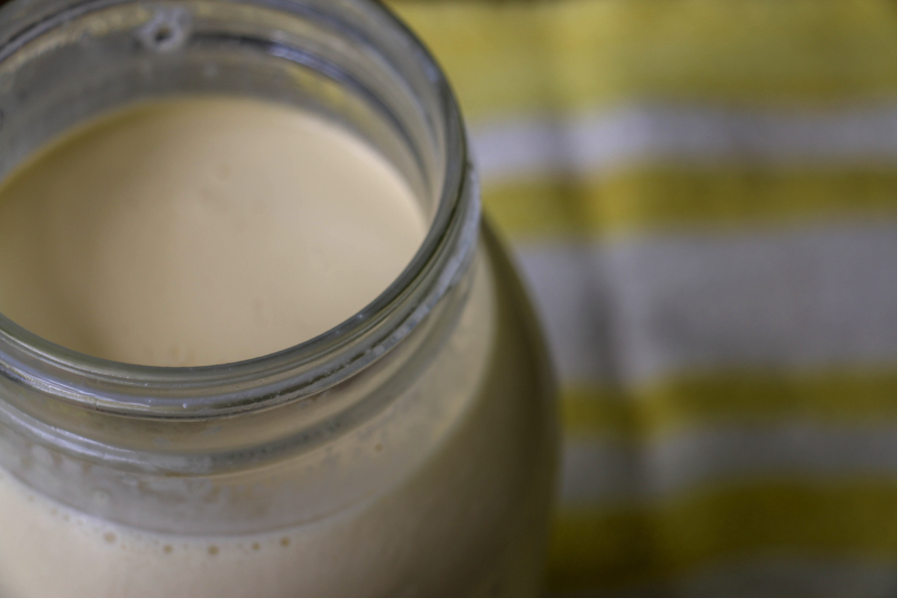
My own fingers return to the worn, but sturdy pages of my summer reading. Their color is precisely that of the cream-line milk I picked up from my neighbor’s farm on Saturday morning, a great blessing in a world of flash-pasteurization and homogenization. Mind racing to angelic pastures and milk-laden riverbanks, still I lament for large-scale normalcy of slaughter within our dairy industry and pray that I can somehow help reduce ­their suffering.

Jar of Milk

My attention now turns to the human form of suffering in  In a vivid portrait of pain, his initial moment of revelation is presented through the story of a seven-year-old burn victim. He paints the following image.

As a medical student, he was asked to simply hold her uninjured hand for the purpose of calming her down and allowing the surgical resident to remove the dead skin from her body. Although he tried to distract her from her own screams by asking about home, family school… the confrontation with extreme pain surpassed his attempts at small talk.

I could barely tolerate the daily horror: her screams, dead tissue floating in the blood-stained water, the peeling flesh, the oozing wounds, the battles over cleaning and bandaging. Then one day I made contact (Kleinman, xii).

Out of despair, he resorted to more honest inquiry. His question was simple:

How do you tolerate this pain? What does it feel like day after day?

She responded initially with shock and ultimately… honesty. Gripping his hand more tightly, she began to narrate the pain. No more screaming. Now she connected him to a sensation that moments earlier left her isolated in extreme suffering.

The purport of this story is that “the experience of illness has something fundamental to teach us about the human condition, with its universal suffering and death” (Kleinman, xiii). Beyond prescribing illness, a medical practitioner must cultivate compassion for the actual patient because ultimately, the process of healing is one that connects us to the Earth, its inhabitants, and God.

For members of Western societies, the body is a discrete entity, a thing, an “it,” machinelike and objective, separate from thought and emotion. For members of many non-Western societies, the body is an open system linking social relations to the self, a vital balance between interrelated elements in a holistic cosmos. Emotion and cognition are integrated into bodily processes. The body-self is not a secularized private domain of the individual person but an organic part of a sacred, sociocentric world, a communication system involving exchanges with others (including the divine) (Kleinman, 11).

For updates about the PLT Summer Internship, click here. We also post updates online using #PLTinterns. To get these updates please like us on Facebook and follow us on Twitter at @LivedTheology. To sign up for the Lived Theology monthly newsletter, click here.

On the Lived Theology Reading List: Inventing Peace

Inventing Peace: A Dialogue on Perception by Wim Wenders, Mary Zournazi book coverA Dialogue on Perception

In a world filled with so much violence, hate, and injustice, are we truly seeing reality for what it is? In Inventing Peace, Wenders and Zournazi ponder this question and the consequences for seeing the world and peace in the midst of an answer falling short. They tackle this idea as one of today’s most fundamental issues, arguing that a change must be made to our everyday perception and a new visual and moral language for peace be formed. Written in the form of a dialogue, the publication draws inspiration from a variety of disciplines to offer unique means in pursuing and perceiving peace.

Pennsylvania State University’s Emeritus Professor of Philosophy, Alphonso Lingis, reviews:

“The word ‘peace’ evokes vague and negative images. We see violence and war everywhere; we need to learn to see peace. Out of seeing the death of a mother and a brother, and seeing the ruins of 9/11 and women refugees in Africa, Mary Zournazi and Wim Wenders share insights about ways of seeing. The book records the conversations and emails of their exchange as it unfolds, drawing in the thoughts of philosophers and poets and the visions of brother filmmakers Ozu, Kurosawa, Dreyer, Bresson. A very rich and powerful book.”

For more information on this book, click here.

Fellow travelers are scholars, activists, and practitioners that embody the ideals and commitments of the Project on Lived Theology. We admire their work and are grateful to be walking alongside them in the development and dissemination of Lived Theology.

For more of “On the Lived Theology Reading List,” click here. To engage in the conversation on Facebook and Twitter, @LivedTheology, please use #LivedTheologyReads. For more recommended resources from our fellow travelers, click here, #PLTfellowtravelers. To sign up for the Lived Theology monthly newsletter, click here.

God in the dollar bill

Dollar Bill

Last week, for the first time in my life, I gave a homeless man a dollar and felt no suspicion or uncertainty. After breakfast, one of the regular attendees asked me for money so that he could catch a bus to Pantops in order to arrive at his doctor’s appointment on time. Without a second thought, the dollar was out of my wallet and into his hand. However, this response was much more profound as I reflected upon it.

Before I continue, I believe that I should explain one of the reasons that I chose the Haven as my site for this internship. For three years at UVA, my daily routine would take me past the Corner, through the labyrinth of off-grounds houses and to my own house. Similarly, for three years, I was confronted by numerous people asking for money underneath the train bridge on 14th and on the pathway outside of the CVS. And for three years, my conscience was continually bombarded by the convictions of my religious tradition grappling with my own rational self-interest. How could I in good conscience give money to someone I didn’t know, with no way of knowing how they would spend it? How could I negotiate a religious doctrine that advocates for a reckless defense and aid of the poor with its command to be as “wise as serpents?” Where does “blessed are the poor” meet the wisdom given by God who “gives generously to all without finding fault?” (James 1:5). Within the boundaries of developing a theology of hospitality, one of my goals for the summer was to shed light upon this quandary and apparent paradox.

In the past weeks, I have seen hope manifest itself in the midst of deeply rooted social problems, experienced the depths of loneliness and isolation, had my comfort bubble burst and noticed that God moves in the innocuous and mundane to lead to radical transformation. If only I had noticed all of that during my conversation at the Haven with the man in need of a bus pass.

Reflecting on the encounter after the fact, I found help from Nouwen and Loring in understanding my interactions with this man. Nouwen would have characterized the second movement of the spiritual life in me: the move from hostility to hospitality. In this interpretation, we as humans fail to empathize with those around us and are inherently suspicious. Driven by our loneliness and inability to respond to our inner questions in a satisfactory way, we no longer see the problems and struggles of others as similar to our own. Our deficiencies in our own lives bleed into our interactions with the strangers we meet. “In general we do not expect much from strangers” (Nouwen, 68) and when we do, it’s often expecting the worst from them. Loring can be seen as an alternative to this suspicion. His openness to those who are homeless centers around the idea that we cannot try to impose our own desires and expectations on strangers. We often fall into this trap of “heroism,” a term used by Ekblad, assuming that we know what is best for those on the margins. Loring’s solution is to simply ask that person, “How can I be helpful?” Similarly to Nouwen, Loring’s approach calls us to open ourselves to receiving the homeless person as a guest and fellow human rather than a suspicious criminal attempting to steal what is ours. Our transition from hostility to hospitality is thus fulfilled by denying heroism and merely being available to those around us.

However, none of this theological reflection does any good if it cannot be applied back to the original encounter with the man looking for a bus ticket. Can Nouwen, Loring and Ekblad truly be incorporated into the context of the Haven? As previously stated, this introspective look at the influences playing upon me in that moment helps to explain my actions. In that instant, the man was coming to me as someone in need of money for the bus, answering Loring’s question “How can I be helpful?” Similarly, meeting that need reflected hospitality devoid of suspicion and hostility.   However, the practical application of these two theologies only set the stage for the God who takes the mundane and makes it miraculous. After I responded with hospitality (Nouwen) and met a particular need (Loring), the man began to tell me about where he was going, why he needed the money, and how the doctors he was going to see had helped him in the past. The one dollar became the price for seeing into this man’s soul. As I listened to his passions, fears, hopes, and outlook on the world around him, we began to bond. I believe that God used that dollar to humanize this man beyond my own suspicions. God took the theological work of Loring and Nouwen, blended it with my personal experience and doctrinal truth, and the result was a genuine, intimate moment in a seemingly innocuous conversation.

Our response to folks who are homeless should go much deeper than if we feel bad putting a dollar in a pan-handler’s cup. Rather, it should look at the relationships that can be built with those asking for the dollar. For some, being “helpful” is putting a dollar in their cup even if we are absolutely certain that the dollar is spent on what we deem unacceptable. Wisdom should come in prudently analyzing situations in which new, affirming relationships can be created and maintained. In those moments, instead of letting our suspicions and self-interest run wild, what if we looked for God in the innocuous? In the place of scrutiny, we could cultivate a desire for empathy and support, affirming the humanity of those on the margins and working alongside them to break the chains of addiction, mental illness, hopelessness, and isolation. Instead of analyzing others to determine if they are destitute enough for our help, we could direct our wisdom toward affirming the humanity of someone else who may feel completely cast aside. How different would our interactions with homeless people look if we attempted to see God in the dollar bill and pursued the opportunities that he gives to build relationships and show others that they have worth?

For updates about the PLT Summer Internship, click here. We also post updates online using #PLTinterns. To get these updates please like us on Facebook and follow us on Twitter at @LivedTheology. To sign up for the Lived Theology monthly newsletter, click here.

Pizza night

Pizza Night

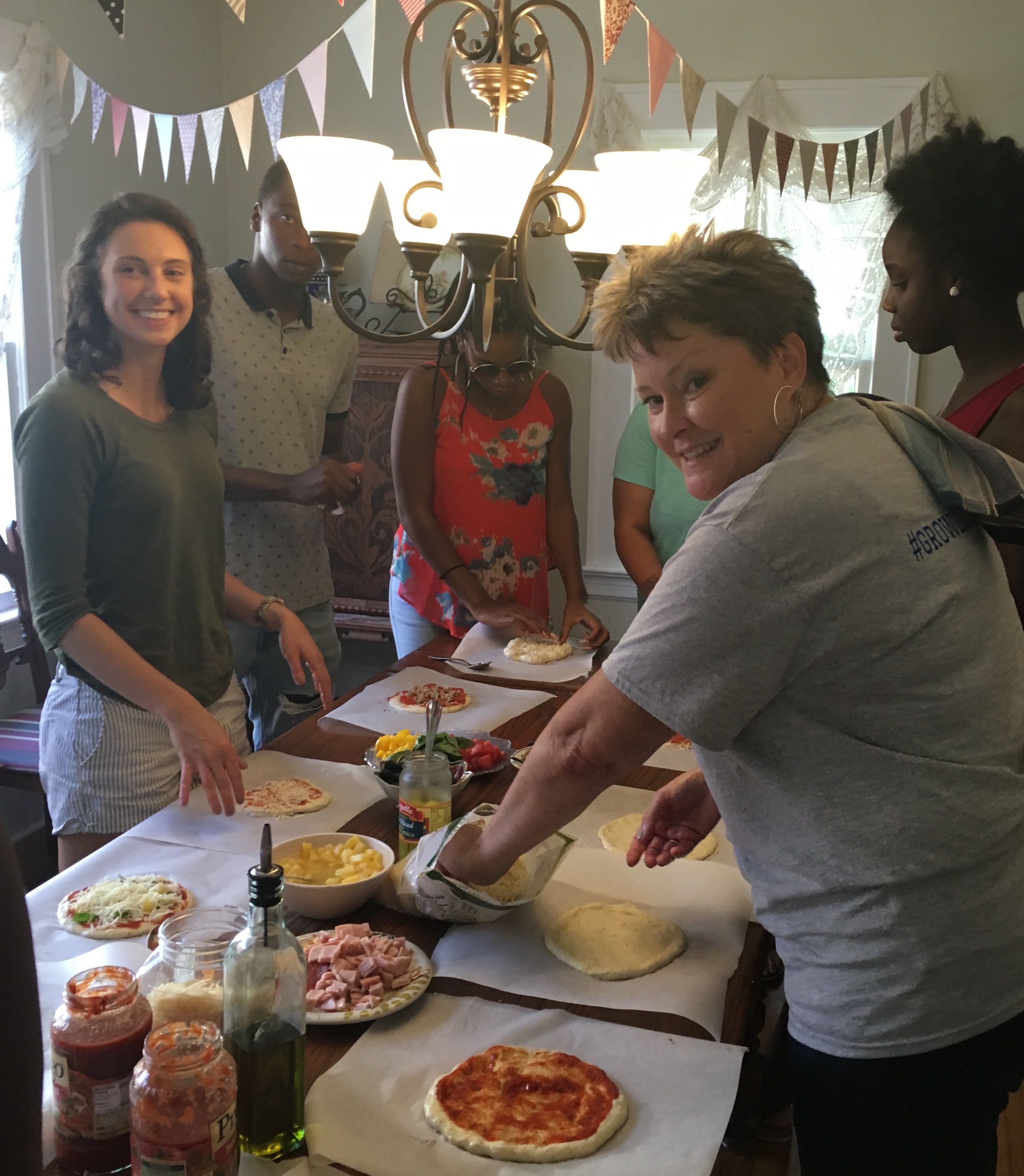
The girls love pizza night at Bible study. Gifted with a perfectly round ball of freshly made pizza dough set atop a crisp piece of parchment paper, each girl transforms into a master chef for the evening. Each step of the process allows them to make choices about the outcome of their raw materials that stretch their creative and culinary limits. Some girls choose to pound out their dough as thinly as possible, anticipating a thin, crispy crust, while others roll some cheese right into the dough with hopes of a gooey, decadent cheesy crust. They get to then choose how much sauce to smatter on their canvas, and how much cheese to sprinkle on top. The star of the show, of course, is the array of toppings: freshly cut tomatoes and bell peppers, backyard-grown basil, juicy black olives, crumbled sausage, classic pineapple and ham, and the crowd favorite, pepperoni. To many of the girls, the options laid out before them seemed overwhelming, and they chose not to stray too far from the safety of cheese and pepperoni, while others threw on everything but the kitchen sink (or in this case, the black olives–apparently not a topping of choice when you’re 12 and 13 years old). Then we retreated to the living room to hunker down for the long 10-minute wait.

I think we all act a little bit like this when faced with choices: either remain in the safety of what you know and love, or hastily pick whatever seems appealing at the moment, which appears to be working until you end up with a bite of banana pepper and pineapple in your mouth and you instantly regret every impulsive decision that led to this moment. When we make decisions, those as inconsequential as pizza toppings as well as the big ones that can change the whole course of our lives, we face a whole host of competing interests and influences. One of the factors that contributes to the way one individual person processes choices is the environment in which he or she grew up.

By pointing out the importance of context in personal development and decision-making, I realize I run the risk of proposing some sort of deterministic view of the world in which people are strictly bound by their environments. I tend to reject this line of thinking, as it boxes people into pre-determined life trajectories that fail to account for the possibility of personal agency, and most importantly, divine power, to break through barriers, perceived or real. I also don’t think it’s very helpful to completely ignore specific contextual limitations in favor of looking only at individual agency. What I see when I look at these young men and women, not just when they are choosing pizza toppings, but when they are grappling with decisions relating to school, work, family, and personal goals, is a mixture of finitude, fear, and freedom to which I can relate in some ways, and in some ways have no context for understanding.

Take, for instance, one of the recently graduated seniors in our ministry who has dreams of going to college but also has responsibility of her nephew and needs to find a job to help support her and her family. As she works through figuring out what her future holds, she faces both her natural finitude as a human, and the specific limits that her situation places on her. She faces the fear of what any wrong step could mean for her and her family and the fear that she might not be able to achieve her dreams.

If this were the end of the story, many people reading this wouldn’t be surprised, as it fits into the common narrative of “under-privileged” youth who are blocked from success because of their circumstances. Bigger Thomas, the protagonist in Native Son, fulfills this role in a more dramatic manner, showcasing the fatal effects of the toxic environment created in the racially and socioeconomically segregated ghettos of this country. Grow up in the inner city and you’re doomed to stay there, with the only means of escape being prison or death. Or so the narrative goes.

What I’ve seen as one of the foundational pieces of Rebirth’s heart is the desire to flip the script on that story. For the young woman I mentioned, the work of God through Rebirth has introduced another element into her decision-making process: freedom. In a spiritual and ontological sense, she, as a follower of Christ, has gained freedom from the power of sin and death and freedom to follow God wherever he may lead. In another sense, she has gained the freedom, through the support and resources available to her through her community and Rebirth, to pursue the kind of education she wants and to find a job that allows her dignity and financial stability. What my night as a pizza artist taught me was that when we use the Kingdom of God as our context, we are all working with the same raw materials, the same human finitude, and the same fears of the future. What I saw as we all stood around the same table making pizzas and encouraging each other to try the olive or to go for the extra sprinkle of cheese was the beauty and power of community to help push each one of us towards the freedom for which we were all created.

For updates about the PLT Summer Internship, click here. We also post updates online using #PLTinterns. To get these updates please like us on Facebook and follow us on Twitter at @LivedTheology. To sign up for the Lived Theology monthly newsletter, click here.